


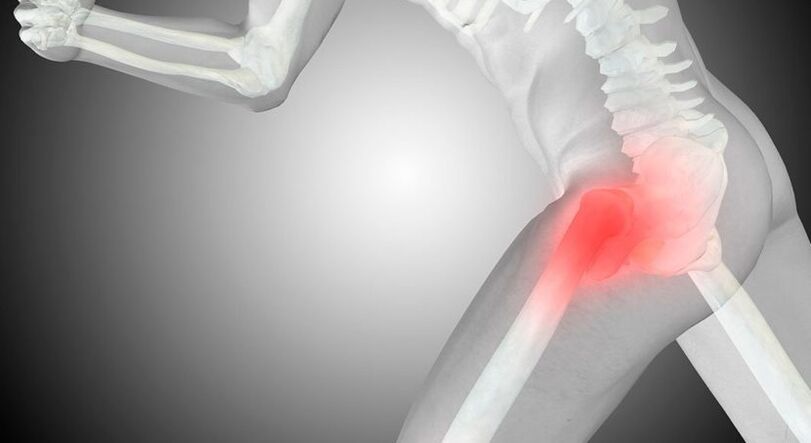
The disease is considered serious and difficult to cure.The earlier treatment of the disease is started, the greater the chances of success.Osteoarthritis of the hip joint combines all diseases that are associated with deviations and disorders in this area.The disease is caused by injury and wear and tear.A common feature of the diseases is the destruction of the articular cartilage layer, causing damage to the joint capsule, bone tissue and muscles.
Osteoarthritis of the hip joint is considered a chronic pathology.The nutrition of the cartilage is disrupted, the tissue is destroyed and mobility is restricted.
What causes the disease?
Causes of the disease:
- Trauma, microtrauma.Often they are not given due attention, the disease develops slowly.
- Heavy workload due to the specifics of the profession, excess weight and the need to travel long distances.
- After taking certain medications, a heart attack in the hip joint occurs.It is caused by a strong stressful situation and large consumption of alcoholic beverages.
- Congenital anomaly.
- Inflammatory process.
- Changes at the hormonal level associated with age.
- Bone destruction, often associated with pathology.
A common cause is microtrauma.The symptoms are not always clearly visible.People who actively play sports or engage in traumatic occupations should be particularly vigilant.If you do not treat the cause in time, the development of osteoarthritis is guaranteed.
Degrees of disease, their symptoms
Symptoms of the disease:
- Constant pain in the groin area.Often spreads to the hip and knee joints.
- Difficulty moving, stiffness.Symptoms include limited mobility.
- The injured limb cannot be moved to the side.
- In severe cases, lameness, gait disturbances, shortening of the lower extremities and atrophy of the thigh muscles occur.
First degree
Osteoarthritis of the hip joint is manifested by pain immediately after physical activity - as a result of long periods of running or walking.A painful feeling arises in the pelvic area and is transferred to the knee and groin area.The gait remains unchanged and no limping is observed.The thigh muscles do not atrophy.If you take a photo, you can see the musculoskeletal growth.
Second degree
The symptoms are increasing.Painful sensations become frequent, constant and occur at rest.When walking for a long time, a person begins to limp.The function of the ligaments of the musculoskeletal system of the thigh is reduced and the range of motion decreases.The picture shows that the gap has almost doubled.Bone growths can be seen on the outer and inner edges.The head of the bone grows, loses its shape, moves upwards and unevenness can be seen at the edges.
Third degree
The painful feeling takes on a painful character.The symptoms are getting worse.Independent movement is limited.A cane or crutch is often used.There is complete atrophy of the muscles of the osteoarticular thigh, lower leg and pelvis.The lower extremities become significantly shorter.When walking, the torso leans, the center of gravity shifts and the load on the damaged joint increases.If you do an X-ray examination, symptoms will be visible: bone growths in large volume.The femoral head enlarges significantly and closes the gap.
Diagnosis of the disease
A timely visit to the doctor and a complete diagnosis are considered the first successful step on the road to recovery.Once the causes are identified, rapid treatment is provided.The disease can be cured at an early stage of development.Suspension of the disease is guaranteed.
X-rays are an aid in making the diagnosis.The method is considered the most reliable.Auxiliary methods for clarifying the causes of the disease are:
- take anamnesis;
- Examination of the patient by a doctor;
- Determining how mobile the joint is.
How to treat the disease?
Treatment with medicinal methods, if necessary in the 1st and 2nd stages of the disease.The third needs surgery.To avoid this, it is worth making an accurate diagnosis in a timely manner and separating arthrosis from other diseases of a similar nature.Treatment should be carried out comprehensively, with:
- conservative means;
- manual treatment;
- therapeutic massage;
- gymnastics
If you combine therapeutic procedures, the pain will be relieved, perhaps it will disappear completely, and blood circulation will improve.It is completely impossible to cure arthrosis of the hip joint.It is quite possible to stop the disease and relieve symptoms.
The following are used for outpatient treatment: painkillers;anti-inflammatory drugs;apply compresses with Dimexide;Physiotherapy is carried out.Treatment will not bring tangible results if it is not carried out comprehensively.
To relieve spasms, massage procedures are performed.The manipulation improves blood circulation in the affected area.This improves the nutrition of the joint.This is a kind of prevention.Carry out massage manipulations, possibly at home, in a clinic.Prescribed after pain relief, when the acute symptoms of the disease are eliminated.The combination of these manipulations with dietary nutrition, physiotherapy procedures, taking chondroprotectors and gymnastics has proven to be effective.
An alternative to massage procedures are muscle relaxants - drugs that weaken muscle tone.A kind of tonic prevention.The strain on the kidneys and liver will increase.
A massage in water leads to successful results.To carry out this procedure, you need special equipment.
Methods of combating the disease at home, preventive measures
Treatment of the disease in the first stages of development, possibly at home.Prevention is carried out, water treatments are carried out, self-massage is carried out, lotions are applied, ointments, balms and infusions are applied.You can use herbal teas.
Treating the disease at home does not give the desired result.Many people consider such an activity a waste of time and effort.It is worth using traditional medicine in conjunction with traditional methods of treatment, then the signs and symptoms of the disease can be alleviated for a long period of time.
Proper nutrition
Complex treatment includes dietary nutrition.To restore cartilage tissue, it must be replenished.He can get it thanks to a balanced diet.An important building block for building muscle mass is protein.It helps to reduce weight and limit the influx of salt into the body.
Tips for proper nutrition:
- Eat foods rich in animal protein: fish, beef, chicken.
- Include dairy products in your diet.Their use is considered an important preventative measure against diseases.
- Forget sweets and starchy foods.
- Cook porridge in water.
- Try to eat 5 servings of vegetables per day.
- Avoid alcoholic drinks, strong tea and coffee.
- Eat small meals, but more often.
If you eat a healthy diet, there will be less strain on the hip joint.Osteoarthritis of the hip joint is considered a severe form of the disease.
Coxarthrosis according to ICD 10
For all countries there are regulatory documents that systematize and influence the human body and its health.Thanks to the approach, there is a single method that determines the treatment of diseases.The international classification of the occurrence of problems and diseases is considered the basis for classification of health care.The document is revised every ten years.
The tenth edition is in force.ICD 10 combines 22 different disease groups.Osteoarthritis of this disease is indicated by ICD-10 codes from M-15 to M-19.Code 16 – Code for osteoarthritis of the hip joint.The code is a kind of disease coding.According to ICD 10, there are 9 forms of the disease.
Surgical intervention
Used when drug treatment has not produced a positive result and the disease is progressing.Methods of surgical intervention:
- Endoprosthetics.Joint replacement with an implant.
- Arthroplasty.Individual joint parts are replaced.
- Osteotomy.The surgical procedure involves partial replacement and fixation of the joints.
- Arthrodesis.During the operation, the bones are connected with special plates.
The first two methods are considered progressive.Through surgical intervention it is possible to preserve the motor function of the damaged lower extremity and the ability to support it.Treatment with surgical intervention is considered a difficult process, accompanied by rehabilitation and postoperative monitoring by a doctor.In principle, the surgical procedure ends successfully and the patient returns to his usual lifestyle.